Reading time: min
With our devicenow DaaS solution, we operate in a fast-moving, modern environment. Speed, performance, and efficiency are our standard. But let’s be honest: sometimes there’s just no time to step back and explore the ideas shaping our industry and discover the great minds behind them.
That’s why we’re launching “3 Questions to…”, a compact Q&A series with thought leaders from our partner network. Only three questions. Only three answers. But plenty of insight. Your knowledge snack for in-between.
HP is a global leader in workplace technology, equipping enterprises with the PCs, printing solutions, collaboration tools, and managed services that keep modern organizations productive. With its focus on the digital workplace of the future, HP combines AI-ready devices, enterprise-grade security, and lifecycle services into an integrated offering that helps IT teams deliver a reliable, scalable employee experience across the entire device estate.
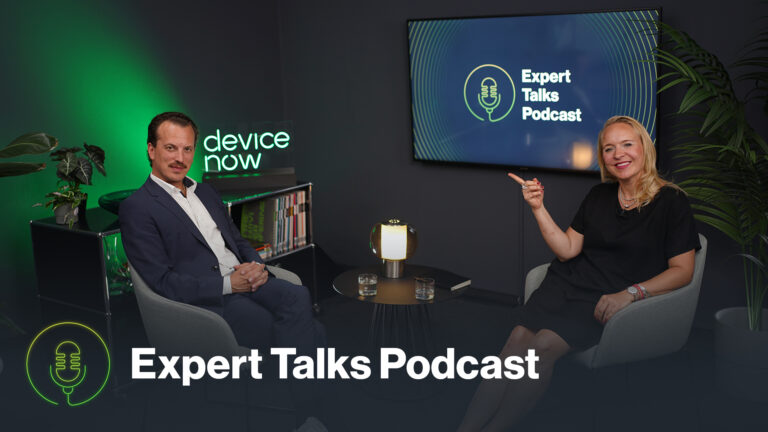
Tanja Langhans is Manager Enterprise Sales South at HP Germany, where she leads strategic growth for one of the company’s most important regions. With more than two decades at HP across inside sales, service consulting, and account management, she has built a career on a simple belief: life begins at the end of your comfort zone.
1. We’re seeing increasing volatility in hardware pricing and availability. How should companies rethink their device strategy to stay resilient in this kind of environment?
In volatile markets, companies need to shift from cost-optimized device strategies to resilience-led ones. That means building flexibility into configurations, planning with supply visibility in mind, and avoiding dependence on a single platform or component. Extending lifecycles selectively and using predictable commercial models also help smooth pricing swings. The goal is no longer the perfect device at the lowest price, but continuous employee productivity despite market disruption.
2. Global supply chains are under pressure again. What are your enterprise customers most concerned about right now when it comes to device availability and planning?
In response to renewed supply chain pressure, enterprise customers are working with us to mitigate risk through early planning, standardization, and built-in flexibility. This includes agreeing on stable platforms, securing volumes earlier in the cycle, and defining approved alternative configurations to avoid disruption if constraints emerge.
From an HP perspective, the focus is on transparent dialogue, predictable delivery frameworks, and jointly agreed contingency options, enabling customers to protect critical rollouts and reduce operational risk rather than reacting late to shortages.
3. AI is moving from the cloud to the device. What are enterprises starting to expect from AI-ready hardware today that they didn’t expect a year ago, and can AI also help in these critical times?
Compared to a year ago, the focus has shifted from “AI capable” to AI-ready by default, meaning predictable on-device performance, dedicated AI compute, and enterprise-grade security without added complexity. In parallel, AI is increasingly seen as a practical stabilizer in uncertain times, helping protect productivity, strengthen security, and enable IT teams to operate more efficiently under pressure.
What Tanja describes in this conversation points to a simple but uncomfortable shift: the playbook enterprise IT has been planning with is no longer enough. Hardware price swings, renewed supply chain pressure, and the arrival of AI on the device are not hitting companies one after another, but as a single, overlapping picture. Reacting with old reflexes, buying as cheap as possible, waiting out shortages, treating AI as something to watch from the sidelines, costs time and room to maneuver. What stands out in Tanja’s answer is how concrete the alternative is: choose platforms deliberately, secure volumes early, build flexibility into contracts, and use AI as a stabilizer rather than a statement. The takeaway is that the next edge in the workplace business won’t come from bigger budgets, but from the willingness to move strategy and execution at the same speed.