Lesezeit: min
Enterprises adopting Device as a Service (DaaS) for workplace hardware can achieve significant financial and operational benefits, according to a new Total Economic Impact™ study conducted by Forrester Consulting.
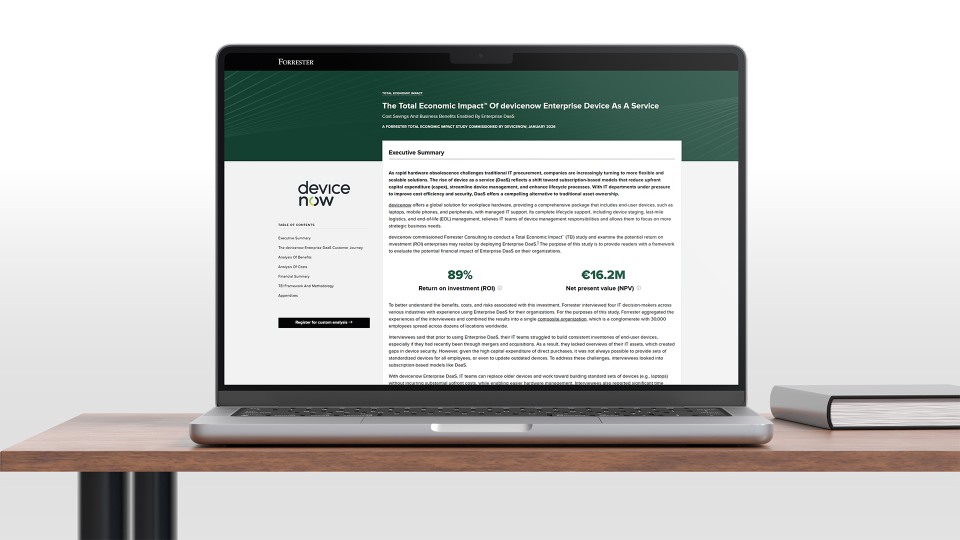
The study, commissioned by devicenow, found that a modeled global organization with 30,000 employees achieved a return on investment (ROI) of 89% and a net present value (NPV) of €16.2 million over three years when replacing traditional device purchasing with a DaaS model.
Forrester based its analysis on interviews with IT decision-makers from organizations in healthcare, professional services, and manufacturing. The findings were aggregated into a composite global enterprise model to evaluate the financial and operational impact of transitioning from traditional device ownership to a subscription-based device lifecycle model.
The study identifies the largest financial impact in hardware procurement and device logistics. According to the analysis, enterprises typically incur average hardware purchase costs of around €1,000 per device, with additional international shipping and transfer costs ranging from €120 to €500 per unit depending on deployment location.
By shifting from direct device ownership, where companies purchase, ship, manage, and replace hardware themselves, to an enterprise DaaS model that bundles hardware and lifecycle services into a monthly subscription, organizations can avoid many of these costs.
As a result, the study estimates €27.1 million in avoided hardware procurement and logistics costs over three years. The shift also helps organizations improve IT budget predictability and reduce large capital expenditure spikes.
The analysis also highlights significant operational efficiencies for IT teams. In traditional device ownership models, internal IT departments must manage provisioning, staging, support, and end-of-life processing for every device.
According to the study, IT teams typically spend approximately 4.5 hours per device on provisioning and staging, plus two additional hours handling return and end-of-life processes.
Under the Device as a Service model, many of these operational tasks are handled by the service provider. The study estimates that organizations can save around 6.5 hours of IT time per device, translating to €4.6 million in IT operational savings over three years for the composite enterprise.
Beyond direct cost savings, the study also highlights productivity improvements for employees. The model assumes that roughly 5% of enterprise devices require unplanned replacement each year due to failure, loss, or theft.
Under traditional procurement models, the average lead time for replacement devices is approximately eight days. In the enterprise DaaS model analyzed by Forrester, replacement time is reduced to around two days.
This significantly faster turnaround reduces employee downtime by approximately 75%, resulting in an estimated €2.7 million in recovered productivity over three years.
Interviewed organizations also reported improved user experience and greater flexibility for IT teams to focus on strategic initiatives rather than operational device management.
Taken together, the financial and operational impacts modeled in the study result in an 89% return on investment and a risk-adjusted net present value of €16.2 million over three years for the composite enterprise organization.
“The study shows that Device as a Service can deliver measurable financial impact while reducing operational complexity for IT teams,” said Christin Wehrstedt, Vice President Global Expansion / Strategic Partnerships & Procurement at devicenow. “By shifting device management to a lifecycle service model, organizations can stabilize IT costs while allowing their teams to focus on higher-value initiatives.”
The Total Economic Impact™ study was conducted by Forrester Consulting on behalf of devicenow. The research evaluates the potential financial and operational impact of Enterprise Device as a Service based on interviews with customers and the development of a composite organization representing a global enterprise with 30,000 employees.
The model assumes that the organization transitions its device estate to a DaaS model over three years, migrating approximately 10,000 devices per year.
All financial results are risk-adjusted and represent modeled outcomes. Actual results may vary depending on organizational size, industry, and implementation approach.
devicenow provides a global Device as a Service solution for workplace hardware with fully integrated lifecycle support. Through standardized global processes, the company manages procurement, deployment, operation, and end-of-life services for enterprise devices. As an alternative to purchasing or traditional leasing models, devicenow enables organizations to equip employees with workplace technology through a flexible, subscription-based approach across more than 190 countries. The solution helps reduce operational complexity, improve cost transparency, and maintain consistent IT standards across international environments